In the maritime industry, the Heating, Ventilation, and Air Conditioning (HVAC) system is often perceived as a secondary utility, when it actually holds a vital and indispensable role. Marine HVAC systems are not merely about providing comfort; they are fundamentally crucial for ensuring safety, protecting sensitive equipment, and maintaining seamless operational continuity on any vessel.
Why Marine HVAC is Non-Negotiable
The marine environment presents distinct and unforgiving challenges compared to terrestrial settings. The combination of corrosive salt-laden air, extreme humidity, and constant vessel movement demands systems that are inherently robust and durable.
A specialized marine HVAC system is engineered to precisely regulate temperature, humidity, air quality, and pressure onboard. Its function extends beyond simple cooling or heating; it acts as the primary guardian of optimal environmental conditions across all types of maritime structures:
- Vessel Types: From luxury cruise ships and high-capacity cargo ships and tankers, to offshore oil rigs and specialized military vessels, all rely heavily on tailored HVAC solutions.
- Key Functions: The system safeguards the well-being of crew and passengers, actively prevents condensation, mold, and corrosion on valuable equipment, guarantees the circulation of clean and safe air, and manages air pressure to ensure structural integrity and safety.
The Complexity of Marine HVAC Design
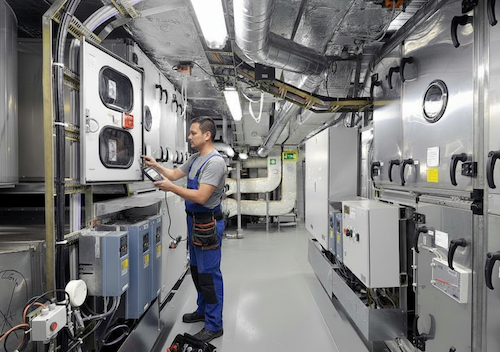
The engineering and installation of a marine HVAC system are significantly more complex than standard land-based applications due to several unique factors:
1. Corrosion Resistance and Watertight Integrity
Marine HVAC components must be constructed from highly corrosion-resistant materials to endure constant exposure to saltwater and high humidity. Components such as condensers frequently utilize specialized alloys like copper-nickel, known for their resilience against seawater. Crucially, every connection, seal, and protective coating must be perfectly watertight to prevent potentially catastrophic failure.
2. Energy Efficiency in Constrained Spaces
Given the premium on space on any vessel, marine HVAC systems must be designed to be as compact and space-saving as possible without compromising efficiency. This necessitates the adoption of advanced technologies, such as Variable Speed Drives (VSD), which allow compressors and fans to dynamically adjust output based on demand, leading to significant energy savings.
3. Stringent Safety Standards and Regulatory Compliance
Marine HVAC is a highly regulated field, requiring strict adherence to numerous international safety standards set by bodies like the IMO (International Maritime Organization) and classification societies (e.g., Lloyd’s Register, Bureau Veritas). These standards govern:
- Material Certification and the Type of Refrigerants used.
- Integrated Fire Safety Systems and Emergency Ventilation to prevent the buildup of smoke or toxic gases.
All components must pass rigorous testing to ensure reliability, particularly in emergency scenarios.
4. Customization Based on Vessel Type and Operation
The HVAC requirements for a passenger cruise line differ fundamentally from those of an underwater military submarine or an offshore platform. Each design must be custom-tailored based on:
- Capacity Load: The number of personnel and heat-generating equipment served.
- Operating Environment: Whether the vessel operates in extreme Arctic temperatures or high tropical humidity.
- Specialized Needs: Including controlled positive pressure rooms, frozen food storage areas, or hospital operating theatres onboard.
5. Maintenance and Repair at Sea
While routine maintenance is essential, conducting repairs offshore presents substantial logistical challenges. Systems must be engineered for easy accessibility for inspection and maintenance, utilizing highly durable components and readily available spare parts to minimize downtime.
End-to-End Solutions from PT Satake Fimar Indonesia (SFI)
Marine HVAC Consulting Scope
The Marine HVAC Consulting services at Satake Fimar span the complete engineering lifecycle, delivering expert guidance from preliminary design analysis through to post-commissioning advisory. In the engineering and planning stages, we collaborate closely with clients to define precise HVAC specifications tailored to various maritime assets, including cargo vessels, LNG tankers, offshore platforms, and FPSO (Floating Production Storage and Offloading). Our team executes strict load calculations, optimizes ducting and equipment layouts for confined marine spaces, and formulates robust specification documents tailored for immediate tender or procurement execution. Every recommendation we make is anchored in stringent international standards, fully complying with SOLAS, IMO resolutions, ASHRAE Marine guidelines, and the regulatory demands of leading classification societies.
During the operational lifecycle, we conduct exhaustive technical audits of active HVAC systems. We assess real-world performance versus design parameters, pinpoint the exact causes of capacity loss or energy inefficiency, and deliver actionable assessment reports featuring measurable optimization strategies. Grounded in extensive field experience across high-stakes environments such as BP LNG Tangguh (Sorong, Papua), PT Kilang Pertamina International (Kasim, West Papua), and PT Freeport Indonesia (Mimika). Our team possesses a profound understanding of the complex HVAC challenges inherent to offshore and remote industrial operations. This specialized field intelligence sets us distinctly apart from standard commercial building HVAC contractors.
Given these complexities and challenges, partnering with a specialized expert is essential. PT Satake Fimar Indonesia (SFI) provides comprehensive experience and specialized technical knowledge in marine HVAC. We offer end-to-end solutions, covering design, procurement, installation, and commissioning of advanced systems.
Through our professional approach and utilization of cutting-edge technology, SFI ensures that every marine HVAC project is delivered with maximum efficiency, adheres strictly to international standards, and provides the necessary operational resilience for your vessel or platform.
Ready to discuss optimal HVAC solutions for your maritime assets? Contact PT Satake Fimar Indonesia (SFI) today for a further consultation via WhatsApp at +6282310043646..